beehiiv review (2026): the right newsletter platform for growth?
Heads up: links to this tool are currently NOT affiliate links · this site earns nothing if you click them. If that changes, this notice will say so. Either way the verdict rules stay the same: full disclosure.

The verdict in 30 seconds
8.5/10
beehiiv is the strongest all-round pick for a newsletter you intend to grow and monetize: the free plan is genuinely generous, the growth tools are the best in the category, and the 0% take on paid subscriptions is real money saved. The trade-offs are basic automations and a price jump once you outgrow the free tier.
Best for: creators and solopreneurs starting a newsletter they plan to grow past a hobby, and writers who want sponsorships plus paid subscriptions on one platform.
Skip it if: you need deep marketing automations and complex tagging funnels (look at Kit), or you want zero setup and a built-in reader network (that's Substack, for a 10% cut of paid revenue).
9/10
Ease of use
10/10
Growth tools
9/10
Monetization
6/10
Automations
8/10
Value for money
What's genuinely good
- + Free Launch plan covers up to 2,500 subscribers with unlimited sends and a custom domain (as of Jul 15, 2026)
- + 0% platform take on paid subscriptions on paid plans · Substack charges 10%
- + Referral program, recommendation network, and Boosts are real growth engines, not checkbox features
- + Built-in ad network brings sponsorships to you once your list justifies it
- + Website, newsletter, and archive live in one place · no separate site needed to start
What to know before you pay
- − Automations are basic compared to Kit or ActiveCampaign · fine for welcome flows, limiting for complex funnels
- − Email automations require the paid Scale plan · the free tier is send-only
- − Removing beehiiv branding requires the Max plan at $96/month (as of Jul 15, 2026)
- − Paid plans price by list size, so costs climb as you grow · budget for the jump past 2,500 subscribers
- − Teams are capped at 3 seats on Scale · more seats means Max
beehiiv vs the alternatives at a glance
| beehiiv | Kit | Substack | |
|---|---|---|---|
| Built for | Growing and monetizing a newsletter | Email marketing for a creator business | Zero-setup publishing with built-in discovery |
| Growth tools | Referrals, Boosts, ad network built in | Creator Network recommendations | Reader network and app |
| Automation depth | Basic, on paid plans | Deep: tags, segments, visual funnels | Minimal |
| Cut of paid subscriptions | 0% on paid plans (Jul 15, 2026) | Check live terms | 10% plus payment fees |
| Free plan | Yes, to 2,500 subs (Jul 15, 2026) | Yes, check current cap | Yes, unlimited free publishing |
beehiiv facts verified against the live pricing page July 15, 2026. Substack's 10% is its published standard rate. Always check live pages before deciding.
We run our own newsletter on beehiiv, so this review comes from the inside of the product, not from a features page. Here’s the short version: beehiiv earns its reputation as the growth-first newsletter platform, the free tier is the most generous in the category, and there are three specific costs and limits you should understand before you commit.
Every price in this review was checked against beehiiv’s live pricing page on July 15, 2026. If you’re reading this much later, verify before deciding · these numbers move.
What is beehiiv, actually?
beehiiv is a newsletter platform built by early Morning Brew team members, and that origin shows: everything in it assumes you want the list to get bigger and make money. You get the editor and sending infrastructure you’d expect, plus a full website with an archive, signup pages, and analytics, so a newsletter on beehiiv doesn’t need a separate site to look legitimate.
That’s the core difference from older email tools. Mailchimp and its generation treat a newsletter as a campaign you send. beehiiv treats it as a media property you build.
What does the free plan really include?
More than you’d expect, which is exactly why it converts people. As of July 15, 2026, the Launch plan is free forever, needs no credit card, and covers:
| Included free (Launch) | The catch |
|---|---|
| Up to 2,500 subscribers | Past that, you’re on Scale pricing |
| Unlimited email sends | Sending is free; automating isn’t |
| Website + newsletter archive | beehiiv branding stays on |
| Custom domain | Setup is on you |
| Campaign analytics | Advanced analytics sit on paid plans |
| Recommendation network | Two-way: you recommend others too |
The honest read: 2,500 free subscribers with unlimited sends is the best free deal among serious newsletter platforms right now. The free plan’s real job is to get you invested before you hit the automation and monetization walls, and it does that job well.
Where does it start costing money?
Two walls, in practice.
The automation wall. Welcome sequences and any email automation require the Scale plan. On the free tier you can send broadcasts and nothing else fires automatically. For a weekly newsletter that’s survivable; the moment you want a proper welcome series, you’re paying.
The size wall. Scale starts at $43/month billed annually (as of July 15, 2026) and the price steps up with list size. Max, which unlocks unlimited team seats, up to 10 publications, and removing beehiiv’s branding, starts at $96/month billed annually. Monthly billing costs more on both. None of this is unusual for the category, but map it against your growth plan so the bill isn’t a surprise: a list that grows fast moves through pricing tiers fast too.
What it looks like inside
The post editor is beehiiv’s strongest surface: a clean writing canvas with the styling controls in a right-hand panel, templates one click away, and desktop/mobile previews built in.
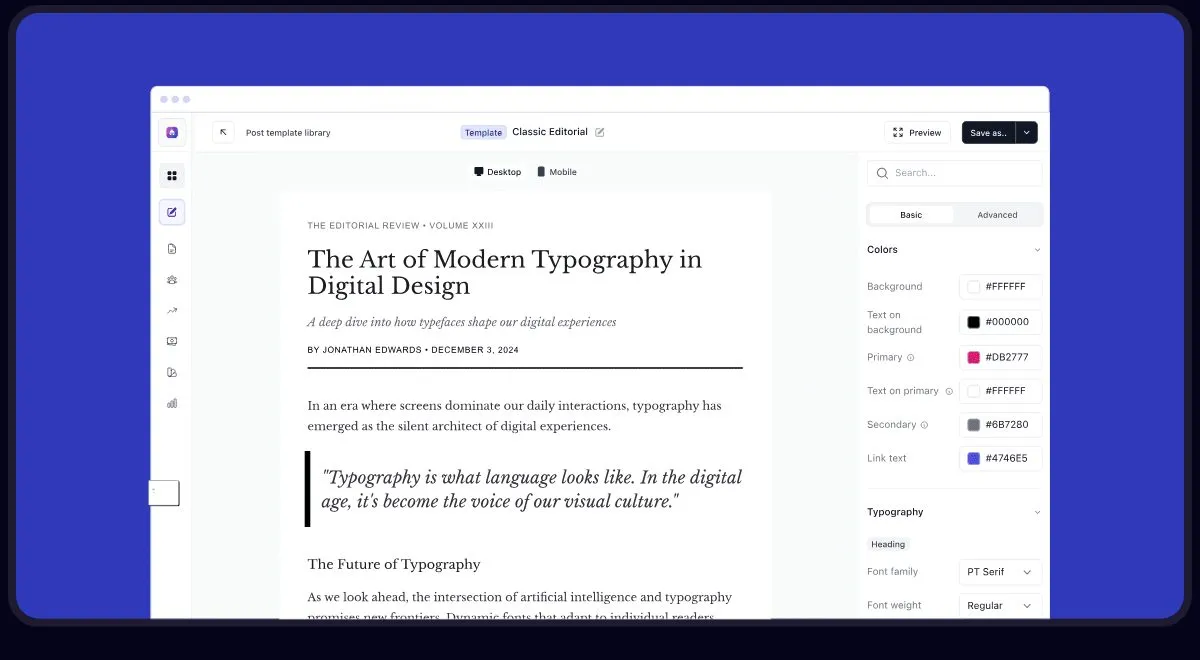 The beehiiv post editor. Source: beehiiv.com
The no-code website builder walks you through template, color palette, and typography, then generates the site and archive around your newsletter.
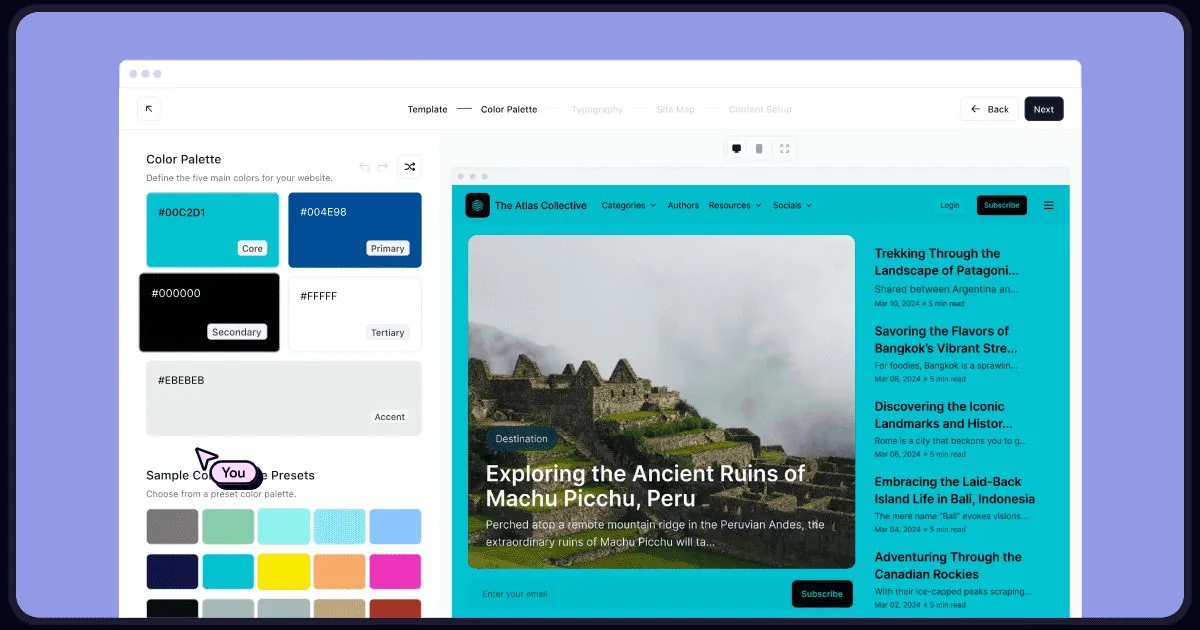 The website builder’s setup flow. Source: beehiiv.com
What’s actually good (the growth machinery)
This is why people pick beehiiv over everything else, and it matches our experience running on it:
- The referral program is built in: readers earn rewards for sharing, and you configure it in an afternoon instead of duct-taping a third-party tool.
- The recommendation network sends real subscribers. When related newsletters recommend yours at signup, growth compounds without ad spend.
- Boosts flip that into a marketplace: pay other newsletters per subscriber they send you, or earn by sending subscribers to others.
- The ad network matters once you have an audience: beehiiv brings sponsors to you, which removes the worst part of newsletter monetization, the outbound sponsor hunt.
- Paid subscriptions with a 0% take on paid plans: you keep subscription revenue minus standard payment processing. Substack’s 10% cut is the obvious contrast, and on a real paid list the difference funds the beehiiv bill by itself.
Here’s what an ad offer looks like from the publisher’s side: the brand, the CPC, an estimated payout you can model against your click-through rate, and the creative versions you can accept or decline.
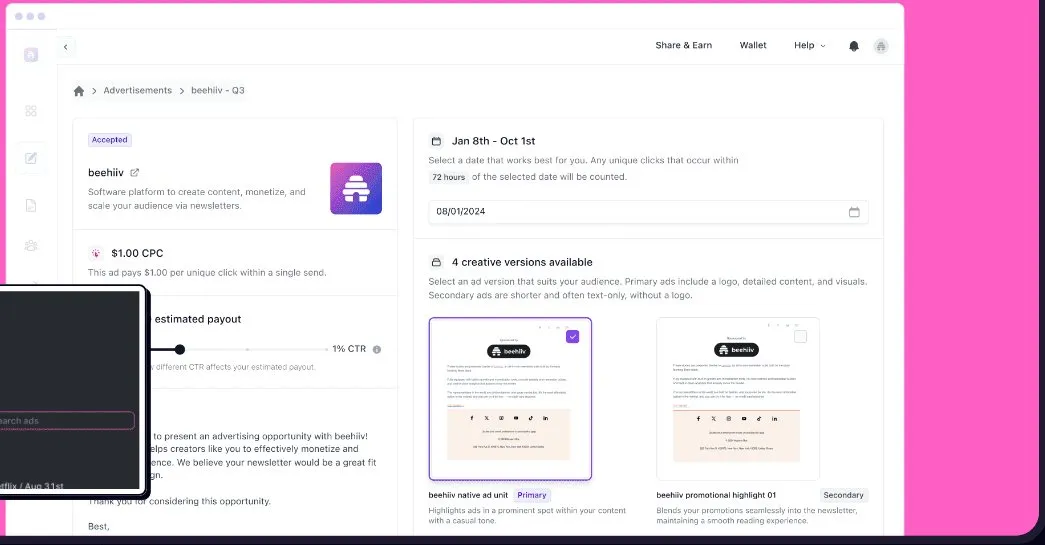 The ad network’s offer view, with beehiiv’s own demo figures. Source: beehiiv.com
What’s missing or annoying
An honest review has to hold these against it:
- Automations are shallow. Compared to Kit or ActiveCampaign, beehiiv’s automations cover the basics: welcome flows, simple triggers. If your mental model is “email funnels with branching logic and behavioral tags,” this is not that tool.
- It wants to be your whole stack. The website, archive, and signup flow are convenient, but if you already run a site you care about, you’ll maintain two homes.
- Branding removal is expensive. “Powered by beehiiv” stays on your work until the $96/month Max tier. Fine for most; galling for brand-sensitive publishers.
- Costs scale with success. The per-tier pricing means your fixed cost rises with list size regardless of revenue. Budget on your projected list, not your current one.
beehiiv vs the alternatives, in one honest paragraph each
Kit (ConvertKit): the better email marketing tool. Deeper automations, tagging, and segmentation, built for creators selling products. Weaker as a growth-first newsletter home: nothing in Kit matches the referral program, Boosts, or the ad network. We run both for different jobs, and that split · beehiiv for the newsletter, Kit for the business email · is common for a reason.
Substack: the fastest start and a real discovery network, at the price of 10% of your paid revenue forever and less control over design, data, and monetization. Choose it for zero setup and built-in readers; leave it when the 10% starts feeling like rent.
Ghost: the self-owned publishing route: open source, full control, memberships without a platform cut (you pay hosting instead). More setup, more maintenance, best for the technically comfortable publisher.
Who should actually sign up
Pick beehiiv if the newsletter is the product: you’re building an audience you intend to monetize through sponsorships, paid tiers, or as the front door to your business, and you want the growth tooling working for you from day one. Start on the free plan, prove the habit, and upgrade when the automation wall or the 2,500 cap actually bites.
Skip it if you need marketing-automation depth (Kit), zero-effort publishing with built-in discovery (Substack), or full ownership of the stack (Ghost).
The free plan makes this an easy call to test: it costs nothing but an afternoon to find out if it fits.
Questions people actually ask
Is beehiiv really free?
Yes, up to 2,500 subscribers. The Launch plan includes unlimited email sends, a website, custom domains, and campaign analytics at no cost, with no credit card required (verified July 15, 2026). What it does not include: email automations, the ad network, and paid-subscription features, which start on the Scale plan.
How much does beehiiv cost after the free plan?
As of July 15, 2026, Scale starts at $43/month billed annually and Max at $96/month billed annually. Both price up with list size, and monthly billing costs more than annual. Check beehiiv's live pricing page before deciding · these numbers change.
Does beehiiv take a cut of paid subscriptions?
On paid plans, no: beehiiv advertises a 0% take rate on paid subscription revenue, though Stripe's standard payment processing fees still apply. Substack, by comparison, keeps 10% of paid revenue plus processing fees.
Is beehiiv better than Kit (ConvertKit)?
Different jobs. beehiiv is built around growing and monetizing a newsletter: referrals, boosts, ad network, paid tiers. Kit is built around email marketing for a business: tagging, segmentation, automations, and selling your own products. If the newsletter IS the product, beehiiv. If email supports a wider business, Kit.
Can I move my existing list to beehiiv?
Yes. Importing a CSV of subscribers is standard, and beehiiv does not make you re-confirm an existing opted-in list. Export works the other way too, so you are not locked in · your list remains yours to take elsewhere.
Bottom line
beehiiv is the strongest all-round pick for a newsletter you intend to grow and monetize: the free plan is genuinely generous, the growth tools are the best in the category, and the 0% take on paid subscriptions is real money saved. The trade-offs are basic automations and a price jump once you outgrow the free tier.
Visit beehiivWritten by the CandorStack team
Developers and entrepreneurs running real online businesses on the tools reviewed here. Every review follows the same public checklist: how we test ·more about this site.